
November 9, 2026
The short answer is yes, but not every fire retardant treatment is designed or certified for exterior use.
Fire retardant wood is increasingly specified for façades and other exterior applications where the use of wood is desired but enhanced fire performance is required. However, achieving the required Euroclass fire classification is only part of the equation. Two products may achieve the same initial fire classification, yet differ significantly in their ability to maintain that performance under long-term environmental exposure.
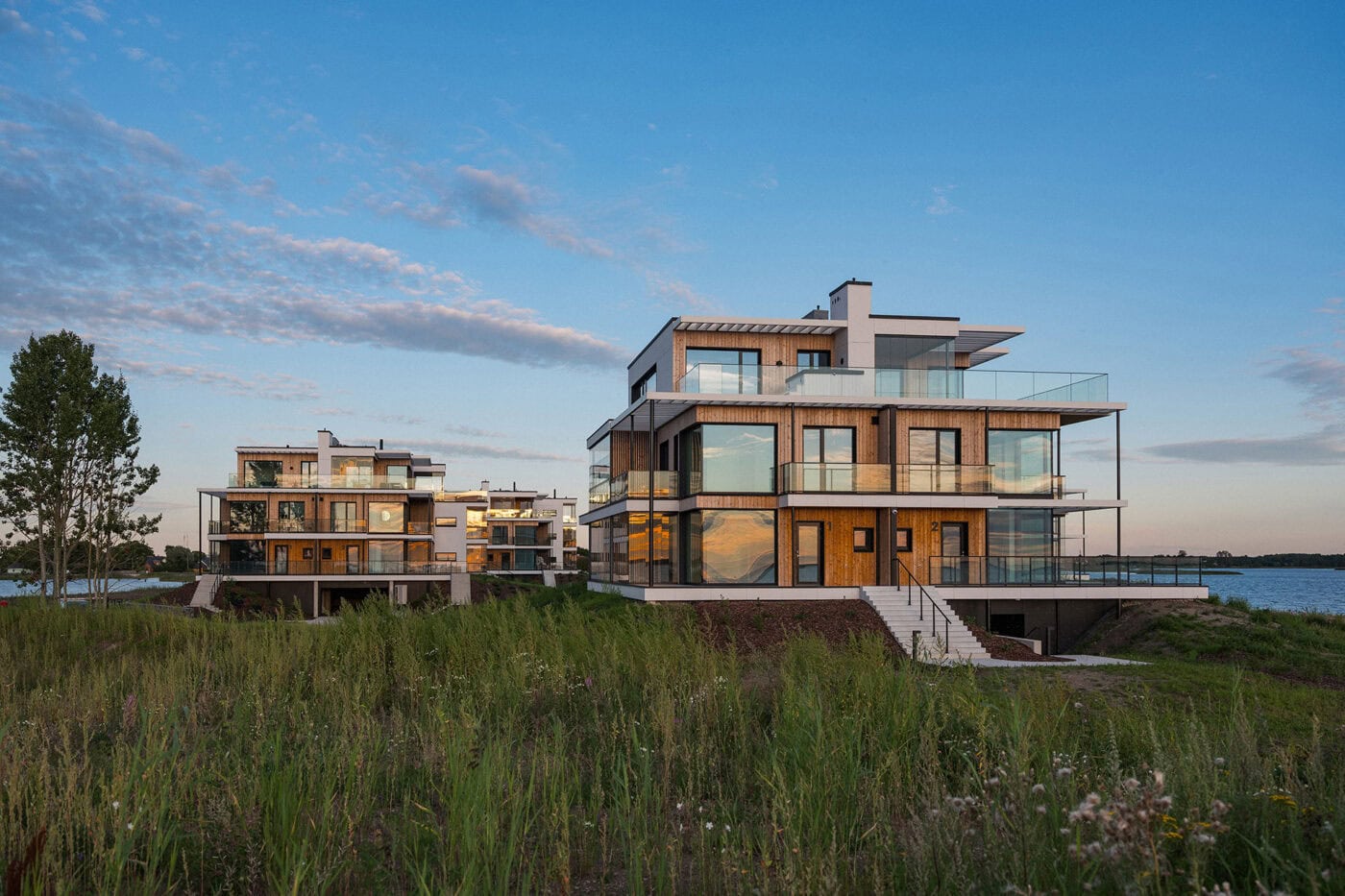
Exterior environments expose wood to a combination of conditions, including:
These conditions may gradually reduce the effectiveness of some fire-retardant treatments if they are not designed for exterior exposure.
Let’s say an exterior timber façade is required to achieve Euroclass B-s1,d0 according to EN 13501-1.
Achieving that classification in the initial fire test is only the starting point. For exterior applications, the question is no longer only “Can the wood achieve Euroclass B-s1,d0?” but also “Will it maintain that classification after being exposed to the environmental conditions expected for its intended use?”
While EN 13501-1 classifies a product’s reaction to fire at the time of testing, EN 16755 verifies whether that performance can be maintained after exposure to the environmental conditions of its intended use.
In simple terms:
| EN 13501-1 asks | EN 16755 asks |
| Does the product achieve the required Euroclass? | Will it still achieve that classification after exposure to its intended service conditions? |
In short, EN 16755 recognises that different service environments place different demands on fire-retardant treatments. It therefore defines 3 different end-use conditions:
INT1 – dry interior environments
INT2 – interior environments where occasional moisture or higher humidity may occur
EXT – exterior exposure to weather
Of these, EXT represents the most demanding end-use conditions due to continuous exposure to weather.
To prove that a product is suitable for exterior use, EN 16755 requires it to undergo weather exposure before its fire performance is assessed again. As part of the procedure, fire-retardant treated wood is exposed either to natural weathering outdoors or to accelerated artificial weathering under standardised conditions. After this weathering period, the product is tested again according to EN 13501-1 to verify whether it still achieves its declared Euroclass classification.
Understanding the conditions behind an EXT classification
It is crucial to understand that a product classified under EN 16755 EXT may fall into one of two entirely different categories:
A product classified with a surface treatment requirement does not meet the EXT standard without that specific treatment. Assuming that an EXT classification always implies full durability without additional coatings is a potentially costly – and dangerous – misinterpretation.
Key recommendation: Always require the product’s classification report and supporting documentation to verify the conditions under which the classification is valid. These documents should be issued by an independent accredited certification body.
While no technology should be judged on its treatment method alone, understanding the main types of fire-retardant systems helps explain why products can perform differently when used outdoors.
| Solution type | Typical application method | Typical exterior considerations |
| Polymer-based systems | Commonly pressure impregnated in the factory | Polymer-based systems use polymer chemistry to fix the fire-retardant components within the wood, making them significantly more resistant to leaching during exterior exposure. As a result, some polymer-based systems are certified for exterior use without additional protective coatings, making them suitable for applications where the natural appearance of the wood is desired. |
| Salt-based systems | Commonly pressure impregnated in the factory | Salt-based systems typically use water-soluble fire-retardant chemicals impregnated into the wood. As these can be susceptible to leaching during exterior exposure, they generally require an approved film-forming coating to maintain certified exterior performance. |
| Fire-retardant coating systems | Surface-applied coating on site | Fire retardant coatings do not alter the fire properties of the wood itself, but act as a protective surface layer. When applied on site, the long-term performance of the system depends not only on the coating itself, but also on the quality of application, the substrate and ongoing maintenance. |
As said, regardless of the technology used, products should always be assessed based on their certified performance rather than the treatment method alone.
When specifying fire retardant wood for exterior use, the key question is whether it has been tested to demonstrate that the required fire performance is maintained after weather exposure. Always require and rely on documentation issued by independent accredited certification bodies.
One example of such a certified solution is Thermory’s cooperation with Woodsafe.
WFX™ is an approved exterior fire-impregnated wood treatment with no requirements for surface treatment according to EN 16755 EXT and American standard ASTM D2898.*
Architects should request the product’s Declaration of Performance (DoP) together with the official reaction-to-fire classification report confirming the declared Euroclass. For exterior applications, it is also important to verify documentation demonstrating the durability of the fire performance after weather exposure, such as testing in accordance with EN 16755, where applicable.

It looks like you're browsing from US. Would you like to visit our US website?